

How to Choose the Right DM Water Plant for You
Introduction
At Nandan Sales we understand that pure water is essential in almost every industrial process today. Whether it’s used for manufacturing, laboratory testing, cooling systems, or product formulation, water quality directly impacts performance, efficiency, and reliability. However, natural water sources often contain dissolved salts, minerals, and impurities that make them unsuitable for such uses.
This is where a Demineralization (DM) Water Plant becomes indispensable. A well-designed DM plant removes unwanted minerals, producing high-purity water that meets industrial standards. Yet, with multiple technologies and models available in the market, choosing the right one can seem complex. This guide simplifies that decision by explaining how DM plants work, what options exist, and what practical factors you should consider before investing.
What is Demineralized Water and Why It Matters
Demineralized (DM) water is water that has been purified to remove almost all dissolved mineral ions—such as calcium, magnesium, sodium, chloride, and sulfate. These ions, though harmless in drinking water, can cause scaling, corrosion, or product contamination in industrial systems.
Industries requiring high-purity water include power generation (boiler feedwater), chemical manufacturing, food and beverage production, and electronics. Even trace levels of silica or dissolved solids can affect efficiency or damage expensive equipment.
By removing these impurities, a DM water plant ensures consistent quality, longer equipment life, and stable process output—key reasons businesses invest in them.

How a DM Water Plant Works
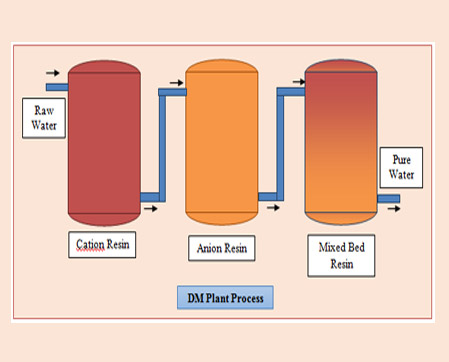
Most DM plants operate on the ion-exchange principle—a proven and energy-efficient process.
1. Pre-Treatment
Before the actual demineralization, raw water is filtered through:
Pressure Sand Filter (PSF): Removes suspended solids and turbidity.
Activated Carbon Filter (ACF): Eliminates odor, color, and organic matter.
Pre-treatment protects the ion-exchange resins from fouling and extends their life.
2. Cation Exchange
In this stage, the water passes through a cation exchange resin that replaces positively charged ions (like Ca²⁺, Mg²⁺, Na⁺) with hydrogen ions (H⁺).
Example reaction:
Ca²⁺ + 2H⁺ (resin) → 2H⁺ + Ca²⁺ (removed)
3. Anion Exchange
Next, the water moves through an anion exchange resin that replaces negatively charged ions (like Cl⁻, SO₄²⁻, NO₃⁻) with hydroxide ions (OH⁻).
Example reaction:
Cl⁻ + OH⁻ (resin) → OH⁻ + Cl⁻ (removed)
The hydrogen and hydroxide ions combine to form pure H₂O.
4. Polishing Stage (Mixed Bed or EDI)
For applications requiring ultra-pure water, the output from the two-bed unit is passed through:
Mixed Bed (MB) Unit: Contains both resins together for final polishing, achieving conductivity < 5 µmhos/cm.
Electrodeionization (EDI): Combines ion exchange with electricity, achieving < 0.5 µmhos/cm conductivity and eliminating chemical regeneration.
5. Regeneration System
Ion-exchange resins lose their activity after continuous use. They are regenerated using:
Hydrochloric acid (HCl) for the cation resin
Caustic soda (NaOH) for the anion resin
This restores the resin’s ion-exchange capacity and keeps the plant operating efficiently.

Types of DM Water Plant Configurations
Every industry’s water requirement is unique, which is why DM plants are available in several configurations:
1. Two-Bed DM Plant
This basic system includes a separate cation and anion exchanger. It is ideal for moderate purity needs and relatively low feed-water TDS.
2. Mixed Bed DM Plant
Used as a polishing unit after a two-bed system or RO unit, it produces water with conductivity as low as 5 µmhos/cm. Common in laboratories and precision manufacturing.
3. RO + DM System
A Reverse Osmosis (RO) unit pre-treats water before ion exchange, significantly reducing the load on resins and chemical consumption. It also improves consistency and reduces regeneration frequency.
4. RO + EDI System
This hybrid setup combines membrane filtration with continuous electrodeionization, providing ultra-pure water (< 0.5 µmhos/cm) without chemical handling. It’s suited for high-end applications like microelectronics and pharmaceutical manufacturing.
5. Mini or Portable DM Plants
Compact, pre-assembled skid units (typically 50–80 LPH) are available for small operations such as labs, battery manufacturing, or pilot setups. These units are simple to install and operate, requiring minimal power and maintenance.
Key Factors to Consider Before Choosing a DM Water Plant
1. Know Your Source Water
The first step is understanding your raw water quality—whether it comes from municipal supply, borewell, or surface sources.
Parameters like TDS, hardness, chlorides, and pH determine the right pre-treatment and resin type. For instance, high-TDS borewell water often needs RO pre-treatment before ion exchange.
2. Define Your End-Use and Quality Goals
Determine the purity you need:
General process use: < 30 µmhos/cm conductivity
High-purity use: < 5 µmhos/cm (Mixed Bed)
Ultra-pure: < 0.5 µmhos/cm (RO + EDI)
Selecting the system based on output conductivity ensures performance and cost balance.
3. Decide the Required Capacity
Estimate your daily water consumption and the Output Between Regeneration (OBR).
Plants are rated from small 50 LPH units to multi-thousand LPH systems. Oversizing increases cost unnecessarily, while undersizing can disrupt operations.
4. Evaluate Space and Installation Needs
Check the available floor area and access for maintenance. Compact skid-mounted models suit smaller plants, while large industrial units may need designated sections with drainage and chemical safety zones.
5. Choose Between Manual and Automatic Operation
Manual models are cost-effective and easy to manage for smaller setups.
Automatic systems with PLC controls offer higher consistency, remote monitoring, and minimal operator dependency—ideal for continuous or large-scale operations.
6. Consider Maintenance and Chemical Handling
Regular resin regeneration and periodic testing of conductivity, pH, and silica are essential for quality control.
Choose systems that use standard chemicals (HCl and NaOH) and have clear labeling and safety protocols.
For RO + EDI units, chemical handling is minimal, which can be a major advantage in clean environments.
7. Material of Construction and Durability
DM plants are usually fabricated with FRP, PVC, or mild-steel powder-coated vessels. Ensure all wetted parts are corrosion-resistant, especially if the system will operate continuously or outdoors.
8. After-Sales Support and Spare Availability
Check for resin brand (Thermax, Purolite, etc.), availability of service kits, and local technical support. Plants designed with standard components (e.g., Astral UPVC piping, Kirloskar pumps) make long-term maintenance easier.
9. Power Consumption and Operating Costs
While ion-exchange systems consume very little electricity, membrane-based systems (RO + EDI) require pumps and DC power for the EDI stack. Compare total lifecycle cost—including chemicals, resin life, and water recovery—before finalizing.
Monitoring and Quality Control
An efficient DM plant is only as good as its monitoring system. Essential instruments include:
Digital Conductivity Meter: Tracks ionic purity at each stage.
Flow Meter: Monitors production rate and detects bottlenecks.
pH Meter: Ensures neutral water output.
Pressure Gauges: Indicate filter performance.
Control Panel or PLC: Coordinates regeneration and alarms.
Maintaining daily log sheets for parameters like pressure, conductivity, and flow rate helps detect resin exhaustion or mechanical faults early.
For example, a sudden rise in cation outlet conductivity signals that the resin needs regeneration.


Cost and Lifecycle Considerations
The total cost of ownership for a DM water plant includes:
Initial investment: Equipment, installation, and commissioning.
Operating costs: Chemicals, power, water, and maintenance.
Resin life: Typically 2–3 years depending on feed water and regeneration frequency.
Automation and controls: Higher upfront cost but lower long-term labor expense.
Plants designed with efficient flow distribution, rust-free materials, and energy-saving valves tend to deliver better ROI. Manufacturers offering pre-dispatch assembly checks and modular upgrades ensure reliability and scalability.
Common Mistakes to Avoid
Ignoring Feed Water Testing: Without lab analysis, system sizing can be inaccurate.
Overlooking Pre-Treatment: Skipping PSF or ACF shortens resin life drastically.
Underestimating OBR: Leads to frequent regenerations and downtime.
Choosing the Cheapest Option: Poor-quality materials increase maintenance costs.
Neglecting Operator Training: Even an automated plant requires basic supervision and data logging.
Avoiding these pitfalls ensures steady performance and long-term savings.
Conclusion: Make a Well-Informed Choice
Selecting the right DM water plant isn’t just about capacity or price—it’s about understanding your process needs, input water quality, and long-term operating goals. By comparing technologies like Ion Exchange, RO + MB, or RO + EDI, and ensuring the plant is designed with the right pre-treatment, automation, and materials, you can achieve reliable, cost-effective water purification for years.
When in doubt, consult an experienced DM water plant supplier or system integrator who can evaluate your feed water report and recommend a configuration that balances performance with budget.
With the right partner and planning, your investment in a DM water plant will deliver consistently pure water and peace of mind for your business operations.
Nandan Sales – Your trusted partner for advanced water treatment solutions in Nagpur and beyond. Delivering excellence in demineralization technology since our inception.
Contact Nandan Sales today to discuss your water treatment needs and experience clean, safe, and sustainable water for your home, business, or industry.
Why Choose Nandan Sales ?
For over three decades, Nandan Sales has been a name associated with trust, quality, and service. We don’t just sell products—we build long-term relationships with our customers. From small homes to large industries, our portfolio covers every water purification need in Nagpur.
When you think of water purifiers in Nagpur, think Nandan Sales. Whether it’s a domestic purifier, a commercial RO system, or a large-scale industrial RO plant in Nagpur, we deliver with excellence.
Our Manufacturing Strength – Arobay
At Nandan Sales, we also operate our own manufacturing unit under the Arobay brand. Arobay specializes in:
- RO water purifiers tailored for borewell and municipal supply in Nagpur.
- RO spares, filters, and membranes to ensure long-term efficiency.
- Customized purification units for residential and commercial projects.